


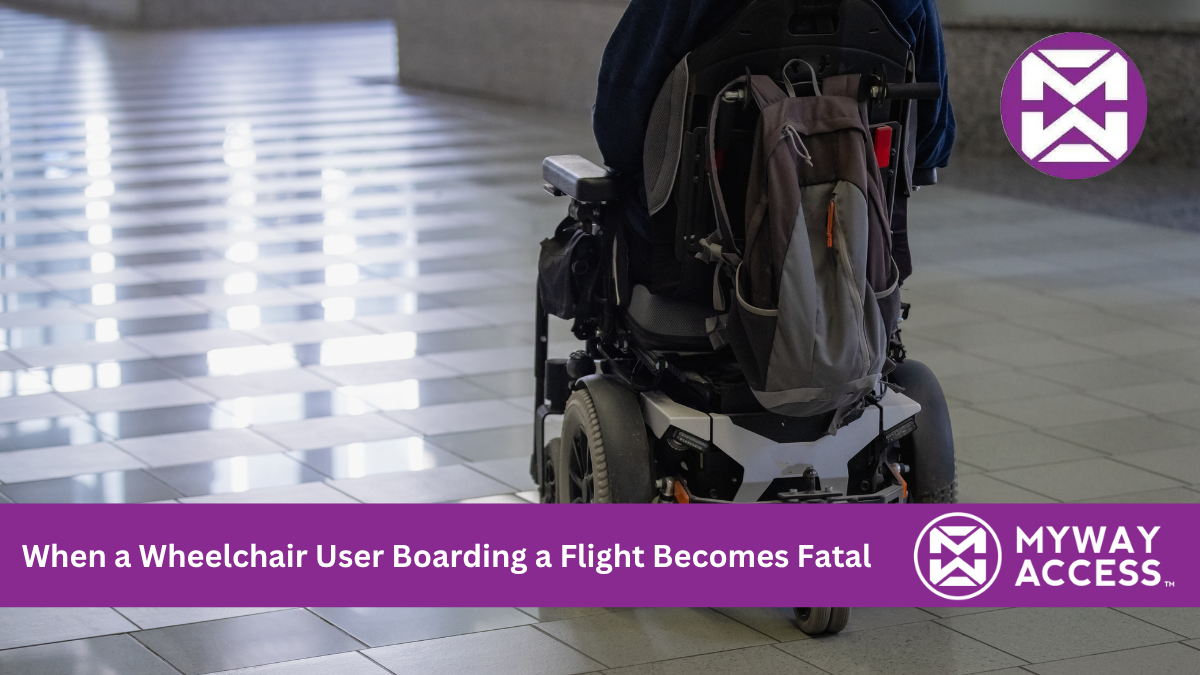
There are moments that cut through everything.
All the policies. All the promises. All the carefully crafted language about accessibility and inclusion.
And what’s left is the truth of how disabled people are treated when it actually matters.
A 24-year-old man, Hunter Adkins, died after falling from an aisle wheelchair while boarding a flight with Allegiant Air at Huntington Tri-State Airport. He lived with muscular dystrophy. He needed support. He relied on a system that is supposed to protect people at one of the most vulnerable points in any journey.
That system failed him.
According to the lawsuit, staff had been told to move faster. At the same time, trained assistants who should have been there were redirected elsewhere. He was transferred from his powered wheelchair into an aisle chair and pushed up the ramp. The chair tipped. He fell face-first.
He died hours later.
It’s easy to call this an accident. It’s harder, but more honest, to recognise what it really is.
This is what happens when pressure is placed on a system that was never built with disabled people at its centre.
Because this isn’t unfamiliar.
If you’re disabled, you know this feeling. It’s in the rush. In the way people move you quicker than they should. In the way your body becomes something to manage rather than something to protect. It’s in the absence of questions. The lack of time. The sense that getting you from A to B matters more than how safely it’s done.
And it always comes down to the same moments. Transfers. The points where your safety depends entirely on the people around you doing their job properly.
Not quickly. Properly.
When care is there, you feel it immediately. When it isn’t, you feel that too. You just hope nothing goes wrong.
Because most of the time, nothing does.
Most of the time, you make the flight. You get to your seat. You tell yourself it was fine.
But “fine” is doing a lot of heavy lifting.
“Fine” often just means nothing went wrong this time.
Behind that are the near misses. The slips that didn’t become falls. The chairs that didn’t tip. The quiet calculations disabled people make in real time, trusting strangers with their bodies and hoping they know what they’re doing.
Because the margin for error is small.
One moment of imbalance. One lack of support. One decision to rush instead of slow down.
That’s all it takes.
The reality in the UK and Ireland
It would be comforting to think this is distant. Something that happened somewhere else, under different conditions. It isn’t.
The same conditions exist here. The same pressure to keep things moving. The same reliance on outsourced assistance. The same gaps in staffing, training, communication. Anyone who has travelled through an airport as a disabled person in the UK or Ireland will recognise parts of this, even if their own journey didn’t end in disaster. Because most of the time, it doesn’t.
Most of the time, you get through it. You make it onto the plane. You tell yourself it was fine. But “fine” often just means nothing went wrong this time. And that’s the part people don’t see. The near misses. The moments where something almost slips, almost tips, almost fails. The quiet calculations disabled people make in real time, hoping that the people around them know what they’re doing, hoping that nothing goes wrong. Because the difference between a safe transfer and a serious incident can be seconds.
One moment of imbalance. One lack of support. One decision to rush instead of slow down. That’s all it takes. And those conditions aren’t rare. They are built into how the system currently operates.
So this shouldn’t be framed as a tragic one-off. It should be recognised for what it is. A warning. A reflection of a system where disabled people’s safety can still be compromised when things get busy, when time gets tight, when priorities shift. Disabled people are not delays.
We are not problems to move through a process. We are people whose safety should never depend on how quickly a plane needs to leave. This wasn’t just a fall. It was a failure. And the real question isn’t how this happened. It’s how often it nearly does. Could This Happen in the UK or Ireland? Yes. And That’s the Problem. The uncomfortable answer is yes. Not because the UK and Ireland don’t have laws. They do.
On paper, both jurisdictions recognise the rights of disabled passengers and place legal duties on airlines and airports to provide assistance. But what happened in the US doesn’t rely on a lack of law. It relies on a gap between policy and practice. And that gap absolutely exists here. The law says one thing. Reality often says another.
In the UK, disabled air travel is covered by UK Regulation 1107/2006 (retained EU law). In Ireland and across the EU, it’s still governed by the same framework. It gives disabled passengers the right to:
Assistance at airports Support when boarding and disembarking
Safe handling during transfers
On paper, that sounds solid.
But rights don’t prevent harm on their own. Delivery does.