


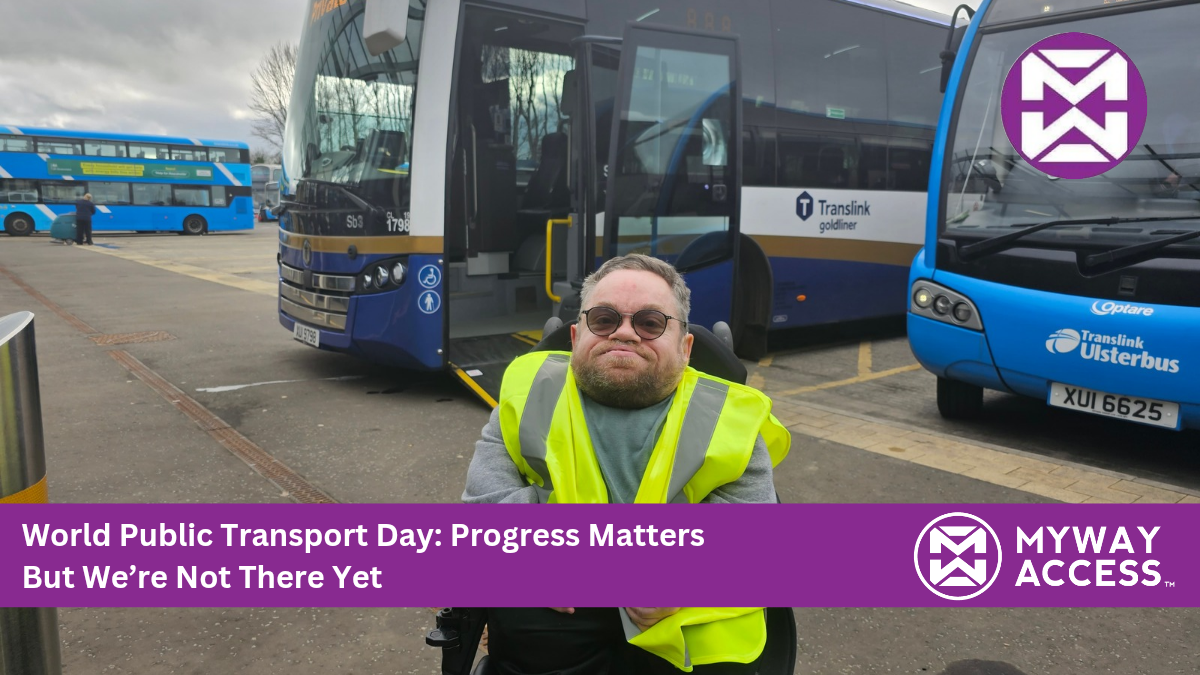
For most people, public transport is simple. You leave the house, get on a bus or train, and go where you need to go. No second thought. No backup plan. No fear of being stranded.
For disabled people, it’s rarely that simple.
As a wheelchair user, I’ve learned that every journey comes with a question mark. Not “what time is the bus?” but “Will I even get there?” And just as importantly, “Will I get home again?”
That uncertainty shapes everything.
The reality behind the journey
There is no such thing as spontaneity when you rely on accessible transport. Every trip has to be planned, often down to the smallest detail. Even then, nothing is guaranteed.
Accessible taxis remain in short supply. Services can be limited, especially in the evenings or in rural areas like here in Tyrone. Even when systems are in place, availability can fall short of real demand.
I’ve said it before, and I’ll say it again:
“Every journey is a logistical challenge.”
That’s not an exaggeration. It’s the reality of trying to participate in everyday life.
When it goes wrong
I’ve been out at events, ready to go home, only to realise there is no way back. No accessible taxi. No alternative. Just waiting and hoping something turns up.
It’s not just frustrating—it’s frightening.
“Being stranded isn’t just inconvenient. It’s scary. It’s exhausting, physically and mentally.”
Experiences like that stay with you. They shape decisions. You start thinking twice before going out. Eventually, you start saying no.
Not because you want to—but because the system makes it too risky.
The good news – progress is happening
But this isn’t the full story.
There has b een progress, and organisations like IMTAC and Consumer Council for Northern Ireland have played a key role in pushing that forward.
IMTAC has consistently worked to ensure disabled people’s voices are heard in transport planning, advising government, influencing policy, and highlighting lived experience.
At the same time, the Consumer Council for Northern Ireland has been holding transport providers to account, representing passengers, and pushing for better, more inclusive services across the board.
Because of that combined pressure, we are seeing change.
Across Northern Ireland, there is growing awareness of accessibility in transport design. More buses are being introduced with accessibility features built in. Rail services, when properly supported, are often more reliable for disabled passengers. And there is increasing recognition that accessible taxi provision must improve.
Most importantly, disabled people are no longer being left out of the conversation.
We are speaking up. And we are being listened to more than before.
That matters.
More than transport – it’s access to life
Public transport isn’t just about getting from A to B. It’s about access to work, healthcare, education, and social life.
When transport works, everything opens up.
When it doesn’t, everything closes down.
“It makes you feel like a second-class citizen—like you were never considered in the first place.”
That feeling doesn’t come from one bad journey. It comes from a system that still isn’t fully designed with disabled people in mind.
Progress isn’t the finish line
The improvements we’re seeing are welcome. They show what’s possible. But they are not enough, not yet.
Accessibility still depends too much on luck. On timing. On whether the right vehicle happens to be available at the right moment.
That’s not equality.
A call for real change
World Public Transport Day should be a moment to celebrate connection. And yes, there is progress worth recognising, much of it driven by advocacy, evidence, and the work of IMTAC and the Consumer Council.
But it should also be a moment for honesty.
We need:
- More accessible vehicles across all services
- Reliable availability, not just theoretical provision
- Disabled people involved at the heart of decision-making
Because this isn’t about convenience. It’s about rights.
It’s about dignity.
And it’s about something most people take for granted:
The freedqom to leave your home and know you can get back again.
Progress is happening. That’s the good news.
Now we need to finish the job.